I know frame size per se is not totally responsible for differences in ride quality because I have a 56cm Ironman that is much more neutral than the Paramount. I have also owned and ridden a 58cm Bianchi that was fairly neutral as well.
Don't get me wrong - the Paramount is nimble and fun to ride: it just requires more attention to steering input, and is a little less stable when one hand is removed from the bar, like when reaching for a water bottle. It takes more concentration to maintain a straight track with the Paramount and I cannot ride it hands-free, even at higher speeds. I would not consider it a good platform for day-long riding.
The Ironman is more neutral and easier to steer with one hand on the bar, but corners just as well as the Paramount. Each seems as if on rails when cornering. Each bike is set up with the same basic fit (reach and saddle position.)
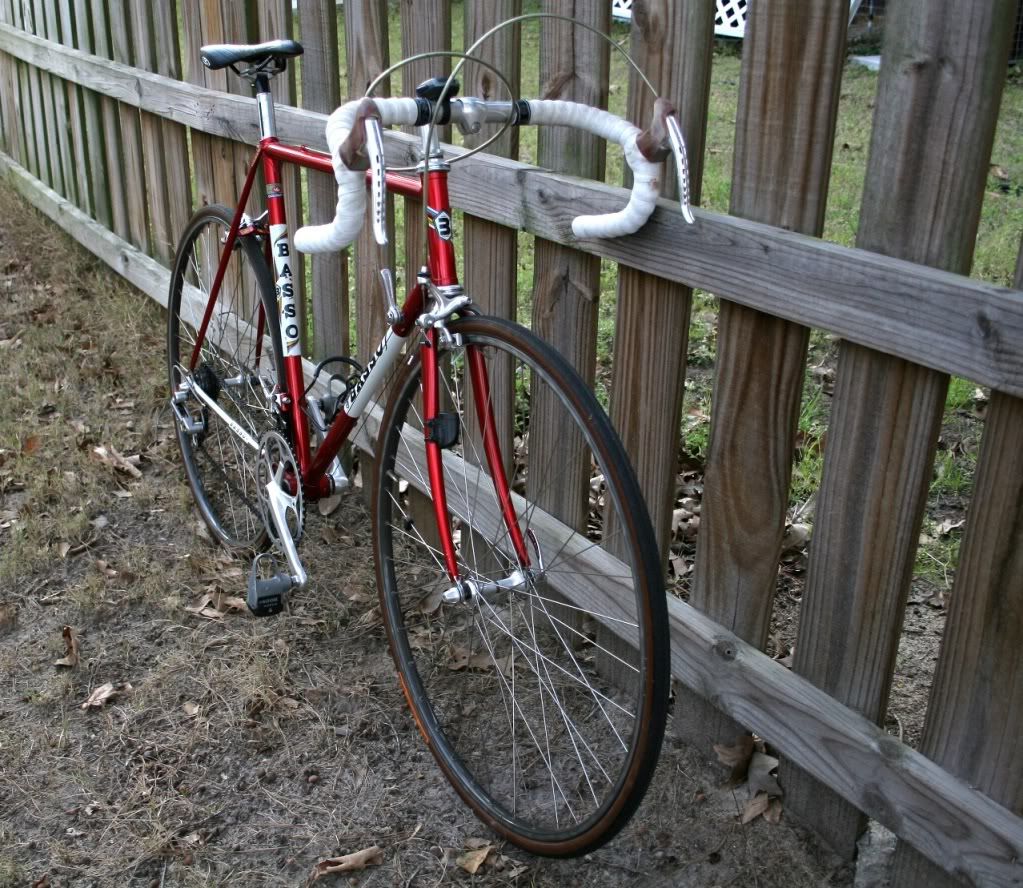
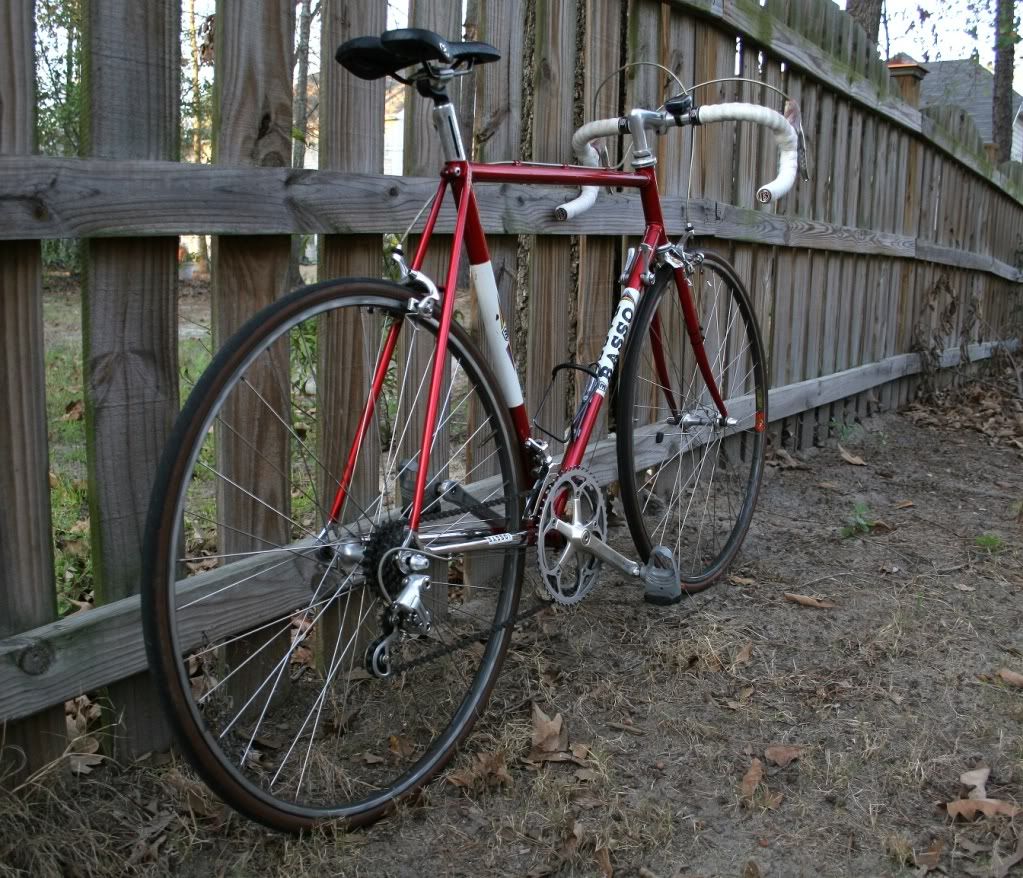
I recently acquired another vintage (Italian) steel road bike - a 1986 Basso Gap, also a 56cm frame. I had no chance to ride it prior to purchase, and was curious to see whether it would handle more like the Paramount or the Ironman, having only frame size information to go on. I suspected (based on frame size) it would handle like the Paramount, but hoped it would handle like the Ironman.
To my relief, it handles like the Ironman, and is a joy to ride.
Here's a couple glamour shots:
All this pondering led me to think about differences in head tube angles, the trail of the front forks,
and wheelbases as other possible contributors to handling characteristics.
I devised a way to measure head tube angles and trail, just to compare the bikes. What I found was certainly curious: the Ironman and the Paramount have head tube angles of 73 degrees, while the Basso's is 74 degrees. The Ironman and Basso have trail of ~59mm, while the Paramount has trail of ~49mm. There is a 1cm difference in wheelbase between the Ironman (100cm) and the Paramount (99cm,) with the Basso dead in the middle (99.5cm.)
For these bikes, it seems differences in trail are the most likely cause of differences in handling, with the higher trail bikes being more stable and almost identical in handling, despite the difference in frame size and head tube angles.
Jan Heine, publisher of Bicycle Quarterly and an expert on randonneur bikes, has posted commentary on bike stability research that suggests no single aspect of a bike's geometry or design is responsible for its stability (i.e. whether it will remain upright while moving), but the unique combination of several variables can certainly affect the feel of the ride.
So what is the point of all this rambling? I'd say it's difficult to predict how well or poorly a bike will handle based on frame size alone, i.e. not all 56cm (plug in your own numbers here) frames will behave the same way. The proof is in the riding, so exercise some care when buying bikes you can't ride first.
Keep pedaling!

No comments:
Post a Comment