Wednesday, March 21, 2012
Going retro?
I've been forced to use down tube shifters again since acquiring the Basso, and the weird thing is I like it!
I'm fully prepared to modernize it with a 9-speed Campagnolo group, but I'm wondering should I bother?
Inspired by this thread on my favorite internet forum, I decided to put a newer wheelset with an 8-speed cassette on the Basso to assess friction shifting across eight cogs. A secondary motivation was to determine how different tires would affect the bike's handling, especially on rough surfaced descents.
With only a couple of rides completed, I have the impression that shifting is certainly no worse, and perhaps more accurate, with less throw of the lever. I'm also getting the hang of shifting both levers with one hand, generally the left. I find this intriguing as I'm right-handed, but the more I think about it, the more sense it makes because the left hand shifts on the front, which usually requires an up or down shift on the rear. The hand is already there, so why not use it?
It was a different matter when I got back into cycling four years ago. My 1988 Nishiki road bike seemed outdated, even primitive. Reaching down to shift was uncomfortable for my (bad) lower back. I was convinced I needed integrated shifters. At first I wanted to "upgrade" the Nishiki, but that would have meant new everything: front and rear derailleurs and a new wheelset, cassette, etc. in addition to the shifters. It made more sense to buy something new or slightly used.
So, I started pricing bikes. Sticker shock stopped me cold. I was leaning towards an aluminum Specialized Roubaix with a 9-speed Ultegra group ($1800 at the time.) I fell in love with a carbon Roubaix, but it was even more expensive. My research led me to look at aluminum frames, for stiffness and efficiency as well as affordability, and I ended up with a gently used Trek 1500. Thrilled to be riding again, I really enjoyed the integrated shifting.
Since then I've occasionally toyed with the idea of getting a carbon bike. I mean, some of the designs are really sexy (as far as bikes go.) When I got the bug for a new bike in 2010, I actually rented several carbon and aluminum bikes, just to see how the alloy frame I wanted compared to its carbon cousins. I preferred the less-expensive aluminum over the entry-level carbon bikes. For my style of riding, there was not enough difference in performance and ride quality to justify the extra expense.
So, as long as I'm comfortable riding the Basso as-is, and the friction shifting is a non-issue, I doubt I'll update it. It's just a lot of fun and a welcome change of pace.
Keep pedaling!
Horatio

Monday, March 19, 2012
My favorite plants and trees
are in full bloom! Wisteria blossoms fill in the empty spaces of still-dormant trees with a purplish-hued cascade of foliage. Dogwood trees dot the landscape with splashes of yellow, white and pink.
Everywhere I turn I see an explosion of color...
and an explosion of pollen!
It's the time of year for extreme contrasts - warmer days, cool nights and frequent storms as nature transitions from dormancy to full force growth and regeneration.
It's also the season when we cyclists transition from limited activity to full-bore training and racing.
The advent of longer days and warmer temps tends to make me want to push myself and go all-out, just from the simple joy of getting out on the bike anytime I want. For me, the hardest part of this time of the year is to reel it in and not fall prey to overtraining.
As a prime example, yesterday I had a goal of riding three hours at my "endurance" pace (HR 149-159 bpm), but because there are hills everywhere I turn, my HR often exceeded 170 bpm, and I frequently observed it in the mid-160s. For the entire ride it averaged 159 bpm, the upper limit of my endurance zone.
That was the same average I managed last week on one of my "brisk" rides, when I was out pushing 20+ mph on the flats. So, am I overtraining on my endurance rides or undertraining on my workouts? Only time will tell.
I have yet to keep a regular training schedule. There are just too many interruptions. But I manage to enjoy the time I do spend riding, and perhaps that's more important than setting and attaining arbitrary performance goals.
If you're riding with a narrow focus all the time, you're bound to miss a lot of pleasurable sights and sensations along the way.
Keep pedaling!
Horatio
Everywhere I turn I see an explosion of color...
and an explosion of pollen!
It's the time of year for extreme contrasts - warmer days, cool nights and frequent storms as nature transitions from dormancy to full force growth and regeneration.
It's also the season when we cyclists transition from limited activity to full-bore training and racing.
The advent of longer days and warmer temps tends to make me want to push myself and go all-out, just from the simple joy of getting out on the bike anytime I want. For me, the hardest part of this time of the year is to reel it in and not fall prey to overtraining.
As a prime example, yesterday I had a goal of riding three hours at my "endurance" pace (HR 149-159 bpm), but because there are hills everywhere I turn, my HR often exceeded 170 bpm, and I frequently observed it in the mid-160s. For the entire ride it averaged 159 bpm, the upper limit of my endurance zone.
That was the same average I managed last week on one of my "brisk" rides, when I was out pushing 20+ mph on the flats. So, am I overtraining on my endurance rides or undertraining on my workouts? Only time will tell.
I have yet to keep a regular training schedule. There are just too many interruptions. But I manage to enjoy the time I do spend riding, and perhaps that's more important than setting and attaining arbitrary performance goals.
If you're riding with a narrow focus all the time, you're bound to miss a lot of pleasurable sights and sensations along the way.
Keep pedaling!
Horatio
Friday, March 16, 2012
Randonneuring plans on hold
This was to be the year for me to venture forth on a randonee or two before summer, and I had every intention of preparing to ride a 200 km event in early April. However, fate (or what-have-you) has stepped in to dash my early season plans once again.
It seems there's always something in the winter months (other than weather) that prevents me from building up endurance times. Shorter days are partly to blame, but there is more variability from parental obligations than anything else.
I had also planned to build the Roberts Audax into a full-blown randonneuse by this time, but it is still sitting disassembled on the back porch. It desperately needs a new paint job, and the funds for that are being diverted into other outlets (like the recently-acquired Basso, plus various spare parts I run across on CraigsList that are too good to pass up on.)
So, where do things stand at this point?
I've pushed the target date for completing an official randonee back to the fall. I'm in no hurry to "get 'er done," so a change in the timeframe is no real concern. On a positive note, I have noticed an improvement in fitness over the course of several weeks, so I have probably met most of my base training requirements.
The main thing to work on now is endurance. With warmer morning temps just around the corner, I can leave home early on any given Saturday, get in rides of several hours, and be home in time for other responsibilities.
If things go well I will do a three-our ride this weekend to assess endurance capability. I can manage 2.5 hour rides with little trouble, so 3+ hours should be manageable.
I'll also devise my own 100 km route to ride sometime before it gets hot, so I can practice nutrition and hydration techniques (as well as pacing!) prior to an official randonee.
Hopefully the Roberts will be ready for trials by then.
Keep pedaling!
It seems there's always something in the winter months (other than weather) that prevents me from building up endurance times. Shorter days are partly to blame, but there is more variability from parental obligations than anything else.
I had also planned to build the Roberts Audax into a full-blown randonneuse by this time, but it is still sitting disassembled on the back porch. It desperately needs a new paint job, and the funds for that are being diverted into other outlets (like the recently-acquired Basso, plus various spare parts I run across on CraigsList that are too good to pass up on.)
So, where do things stand at this point?
I've pushed the target date for completing an official randonee back to the fall. I'm in no hurry to "get 'er done," so a change in the timeframe is no real concern. On a positive note, I have noticed an improvement in fitness over the course of several weeks, so I have probably met most of my base training requirements.
The main thing to work on now is endurance. With warmer morning temps just around the corner, I can leave home early on any given Saturday, get in rides of several hours, and be home in time for other responsibilities.
If things go well I will do a three-our ride this weekend to assess endurance capability. I can manage 2.5 hour rides with little trouble, so 3+ hours should be manageable.
I'll also devise my own 100 km route to ride sometime before it gets hot, so I can practice nutrition and hydration techniques (as well as pacing!) prior to an official randonee.
Hopefully the Roberts will be ready for trials by then.
Keep pedaling!
Thursday, March 15, 2012
Musings on bike handling
I've been wondering lately how the ride characteristics of similar bikes can be so different. In the first post I commented on how stable my Ironman seems in comparison to my Paramount. The Ironman is a 54cm frame and the Paramount 56cm - not a drastic difference.
I know frame size per se is not totally responsible for differences in ride quality because I have a 56cm Ironman that is much more neutral than the Paramount. I have also owned and ridden a 58cm Bianchi that was fairly neutral as well.
Don't get me wrong - the Paramount is nimble and fun to ride: it just requires more attention to steering input, and is a little less stable when one hand is removed from the bar, like when reaching for a water bottle. It takes more concentration to maintain a straight track with the Paramount and I cannot ride it hands-free, even at higher speeds. I would not consider it a good platform for day-long riding.
The Ironman is more neutral and easier to steer with one hand on the bar, but corners just as well as the Paramount. Each seems as if on rails when cornering. Each bike is set up with the same basic fit (reach and saddle position.)
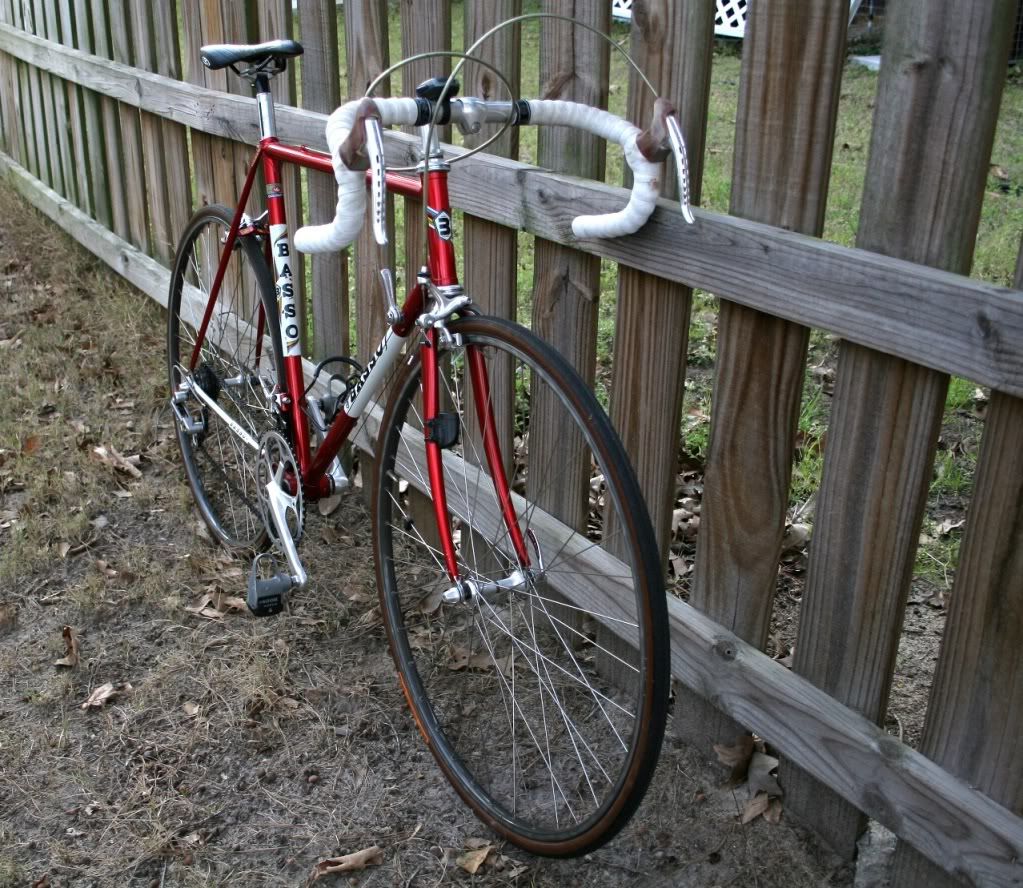
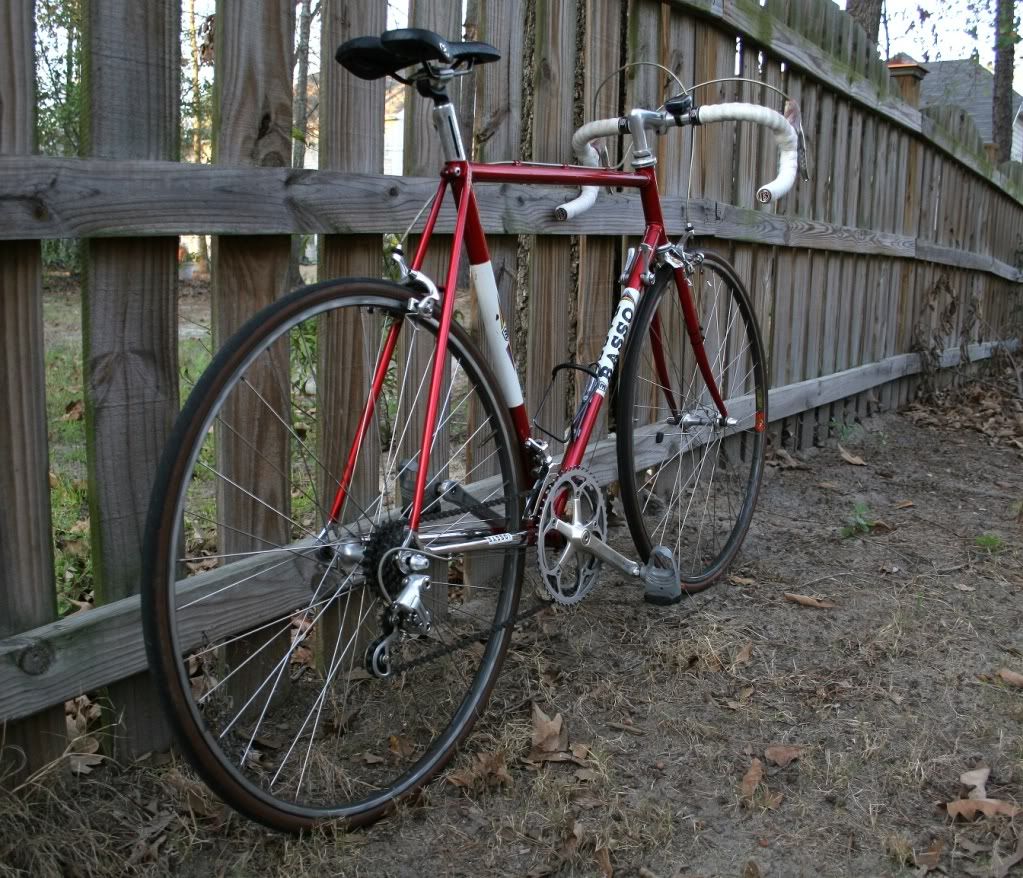
I recently acquired another vintage (Italian) steel road bike - a 1986 Basso Gap, also a 56cm frame. I had no chance to ride it prior to purchase, and was curious to see whether it would handle more like the Paramount or the Ironman, having only frame size information to go on. I suspected (based on frame size) it would handle like the Paramount, but hoped it would handle like the Ironman.
To my relief, it handles like the Ironman, and is a joy to ride.
Here's a couple glamour shots:
All this pondering led me to think about differences in head tube angles, the trail of the front forks,
and wheelbases as other possible contributors to handling characteristics.
I devised a way to measure head tube angles and trail, just to compare the bikes. What I found was certainly curious: the Ironman and the Paramount have head tube angles of 73 degrees, while the Basso's is 74 degrees. The Ironman and Basso have trail of ~59mm, while the Paramount has trail of ~49mm. There is a 1cm difference in wheelbase between the Ironman (100cm) and the Paramount (99cm,) with the Basso dead in the middle (99.5cm.)
For these bikes, it seems differences in trail are the most likely cause of differences in handling, with the higher trail bikes being more stable and almost identical in handling, despite the difference in frame size and head tube angles.
Jan Heine, publisher of Bicycle Quarterly and an expert on randonneur bikes, has posted commentary on bike stability research that suggests no single aspect of a bike's geometry or design is responsible for its stability (i.e. whether it will remain upright while moving), but the unique combination of several variables can certainly affect the feel of the ride.
So what is the point of all this rambling? I'd say it's difficult to predict how well or poorly a bike will handle based on frame size alone, i.e. not all 56cm (plug in your own numbers here) frames will behave the same way. The proof is in the riding, so exercise some care when buying bikes you can't ride first.
Keep pedaling!
I know frame size per se is not totally responsible for differences in ride quality because I have a 56cm Ironman that is much more neutral than the Paramount. I have also owned and ridden a 58cm Bianchi that was fairly neutral as well.
Don't get me wrong - the Paramount is nimble and fun to ride: it just requires more attention to steering input, and is a little less stable when one hand is removed from the bar, like when reaching for a water bottle. It takes more concentration to maintain a straight track with the Paramount and I cannot ride it hands-free, even at higher speeds. I would not consider it a good platform for day-long riding.
The Ironman is more neutral and easier to steer with one hand on the bar, but corners just as well as the Paramount. Each seems as if on rails when cornering. Each bike is set up with the same basic fit (reach and saddle position.)
I recently acquired another vintage (Italian) steel road bike - a 1986 Basso Gap, also a 56cm frame. I had no chance to ride it prior to purchase, and was curious to see whether it would handle more like the Paramount or the Ironman, having only frame size information to go on. I suspected (based on frame size) it would handle like the Paramount, but hoped it would handle like the Ironman.
To my relief, it handles like the Ironman, and is a joy to ride.
Here's a couple glamour shots:
All this pondering led me to think about differences in head tube angles, the trail of the front forks,
and wheelbases as other possible contributors to handling characteristics.
I devised a way to measure head tube angles and trail, just to compare the bikes. What I found was certainly curious: the Ironman and the Paramount have head tube angles of 73 degrees, while the Basso's is 74 degrees. The Ironman and Basso have trail of ~59mm, while the Paramount has trail of ~49mm. There is a 1cm difference in wheelbase between the Ironman (100cm) and the Paramount (99cm,) with the Basso dead in the middle (99.5cm.)
For these bikes, it seems differences in trail are the most likely cause of differences in handling, with the higher trail bikes being more stable and almost identical in handling, despite the difference in frame size and head tube angles.
Jan Heine, publisher of Bicycle Quarterly and an expert on randonneur bikes, has posted commentary on bike stability research that suggests no single aspect of a bike's geometry or design is responsible for its stability (i.e. whether it will remain upright while moving), but the unique combination of several variables can certainly affect the feel of the ride.
So what is the point of all this rambling? I'd say it's difficult to predict how well or poorly a bike will handle based on frame size alone, i.e. not all 56cm (plug in your own numbers here) frames will behave the same way. The proof is in the riding, so exercise some care when buying bikes you can't ride first.
Keep pedaling!
Tuesday, March 13, 2012
Where did the time go?
Wow! It's been a month since the inaugural post, and I haven't added a thing. Shame on me! Especially since there have been several noteworthy developments.
First, I defeated the stuck seatpost in the Centurion Ironman. It took several hours of sawing to cut through year's worth of corrosion, but it finally gave in before I did. Here is the result of all that effort:

It's plain to see why no amount of banging, twisting, soaking with FreezeOff, or PB Blaster would loosen its death-grip inside that tube. I fault the previous owner for neglect, but I think the fluted design of the SR post is also to blame: there are lots of channels for moisture to enter into the tube.
The inner surface of the seat tube was so rough I could not fully insert a new post! I devised a make-shift sandpaper holder and sanded off the corrosion, then coated as much of the tube as I could with grease. Now the new seat post can be inserted to the hilt!
I also began systematically treating rust on the outside of the frame. The damage there was mostly cosmetic, but the frame now has glaring bare spots that resemble scars. I spent the better part of a Saturday morning dabbing on rust remover, then rinsing, drying, scrubbing and repeating until some metal was finally revealed. After lunch I went to Lowes and purchased a Dremel attachment, which made some of the clean-up much quicker.
I have been unable to match the fuscia paint, so I'm tempted to just put clear coat over the bare spots and let it display the scars of a hard life.
If ever I acquire another rusty frame like this, I'll bathe it in a mild acid solution to dissolve the corrosion. Otherwise, it's too time consuming. (Learning things "the hard way" is apparently a genetic predisposition within my family.)
Why am I going to so much trouble for this frame, you ask? The Ironman, at least in my estimation, has unbelievable ride qualities for a Japanese-made bike of this era. It is stiff and efficient, yet at the same time comfortable enough to ride for hours on end. These qualities must be a combination of its basic geometry and high-quality steel tubing. Ironman bikes in my size do not appear on the market that often.
The Ironman series was made from Tange #1 double-butted chromoly (their highest quality tubeset). It is no doubt comparable to top-of-the line tubing from Reynolds and Columbus from the same era.
Since it is such a joy to ride, I want to preserve my red Expert as long as possible, but I also want to enjoy that Ironman ride quality, even in poor weather. So this so-called "Miami Vice" Expert is destined to become my beater bike.
It will also be rebuilt with the original downtube shifters and mid-80s Shimano 105 components. It seems I'm being drawn once again to the simplicity of DT shifters, but that's material for another post.
Keep pedaling!
Horatio
First, I defeated the stuck seatpost in the Centurion Ironman. It took several hours of sawing to cut through year's worth of corrosion, but it finally gave in before I did. Here is the result of all that effort:
It's plain to see why no amount of banging, twisting, soaking with FreezeOff, or PB Blaster would loosen its death-grip inside that tube. I fault the previous owner for neglect, but I think the fluted design of the SR post is also to blame: there are lots of channels for moisture to enter into the tube.
The inner surface of the seat tube was so rough I could not fully insert a new post! I devised a make-shift sandpaper holder and sanded off the corrosion, then coated as much of the tube as I could with grease. Now the new seat post can be inserted to the hilt!
I also began systematically treating rust on the outside of the frame. The damage there was mostly cosmetic, but the frame now has glaring bare spots that resemble scars. I spent the better part of a Saturday morning dabbing on rust remover, then rinsing, drying, scrubbing and repeating until some metal was finally revealed. After lunch I went to Lowes and purchased a Dremel attachment, which made some of the clean-up much quicker.
I have been unable to match the fuscia paint, so I'm tempted to just put clear coat over the bare spots and let it display the scars of a hard life.
If ever I acquire another rusty frame like this, I'll bathe it in a mild acid solution to dissolve the corrosion. Otherwise, it's too time consuming. (Learning things "the hard way" is apparently a genetic predisposition within my family.)
Why am I going to so much trouble for this frame, you ask? The Ironman, at least in my estimation, has unbelievable ride qualities for a Japanese-made bike of this era. It is stiff and efficient, yet at the same time comfortable enough to ride for hours on end. These qualities must be a combination of its basic geometry and high-quality steel tubing. Ironman bikes in my size do not appear on the market that often.
The Ironman series was made from Tange #1 double-butted chromoly (their highest quality tubeset). It is no doubt comparable to top-of-the line tubing from Reynolds and Columbus from the same era.
Since it is such a joy to ride, I want to preserve my red Expert as long as possible, but I also want to enjoy that Ironman ride quality, even in poor weather. So this so-called "Miami Vice" Expert is destined to become my beater bike.
It will also be rebuilt with the original downtube shifters and mid-80s Shimano 105 components. It seems I'm being drawn once again to the simplicity of DT shifters, but that's material for another post.
Keep pedaling!
Horatio
Subscribe to:
Posts (Atom)